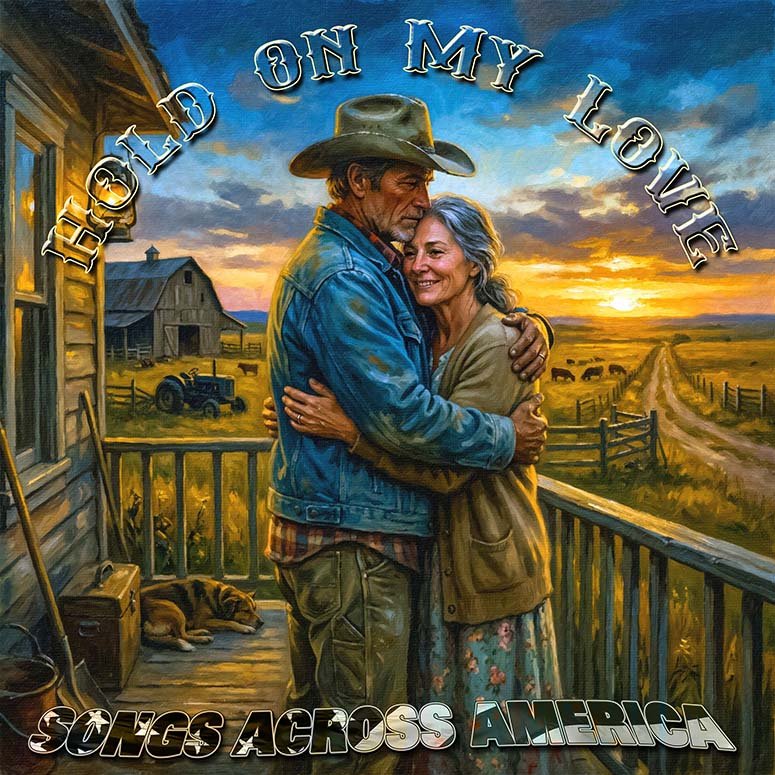
"Hold On My Love©"
Lyrics by M. S. McKenzie | Performed by Songs Across America, Protected by Copyright
Streaming Services Music Link

Streaming Services Music Link
~ Associated State Links ~
[ KS Home Pg. | KS Gallery Pg. | KS Attractions | Best Small Towns | Best Small Cities ]
"Hold On My Love"
Why I Wrote This Song
I wrote "Hold On My Love" for the quiet steadiness of Kansas ranch life, the fence lines checked at dawn, the hay hauled past Hutchinson, the small waves to neighbors who don't need explaining. I wanted the chorus to be less a love song in the usual sense and more a survival pact, your steady hand keeps me calm when the world overwhelms, because that's what partnership actually looks like on land this demanding.
The story behind the song is in the turn toward late summer, when the pasture grays and he counts feed like a man counting time. I didn't want to hide the hard seasons, the ones that take more than a body can plow, because a marriage built on real land has to hold both the Saturday night dancing in Wichita and the quiet fear at the gate. Love keeps a promise when you're feeling alone is the whole argument of the song.
Genre:
Warm country ballad moving between upbeat fiddle-and-banjo passages and softer, string-forward verses, tracing a full season from dawn labor to late-summer hardship.
Theme:
Rural marriage and endurance, the rhythms of ranch labor, inherited resilience across generations, and love as a steadying promise through hardship.
Primary Subject:
A Kansas rancher and his partner, and the promise that carries them through both the town's Saturday joy and the season's hardest stretches.
Mood:
Tender and steady, warming into joy at the dance, deepening into quiet ache before resolving into enduring devotion.
Core Message:
Real partnership isn't only the easy seasons; it's a promise kept quietly through the hard ones too, a steady hand that holds when the land and the work threaten to overwhelm.
Original Song Lyrics: Written by M. S. McKenzie, All Rights Reserved
[Verse 1]
Morning breaks on the Flint Hills, gold on the grain
He checks every fence line while the tall wind understands
A quiet prayer for the calves, for the heat and the rain
Then he heads into daylight with work on his hands
[Chorus]
Hold on my love for when that long night comes… I'm coming home
Your steady hand keeps me calm when the world overwhelms
Hold on my love…you're the only reason I ever make it home
And I'll be there lying beside you when that morning comes
[Verse 2]
He hauls the morning hay past Hutchinson as the sun climbs high
Dust in the mirror, but his eyes stay clear
A wave to the neighbors, no need to ask why
On roads that remember, year after year
[Verse 3: Upbeat: violin lines enter, banjo joins, guitar pulse steadies]
Down by Wichita they're laughing in Saturday light
Boot heels on floorboards: the whole town turns bright
Fiddles like skylarks, banjo rolling just right
And every tired worry feels a little more light
[Chorus]
Hold on my love for when that long night comes… I'm coming home
Your steady hand keeps me calm when the world overwhelms
Hold on my love…you're the only reason I ever make it home
And I'll be there lying beside you when the morning comes
[Verse 4: Sadder: piano forward, strings soften, banjo fades out]
Late summer cracks open: the pasture turns gray
He counts out the feed like a man counting time
Still, he stands at the gate at the end of the day
And tells the kids softly: we'll be fine, we'll be fine
[Verse 5: Sadder: strings swell with ache, guitar quieter]
Along the Arkansas River the cottonwoods bow
He thinks of his father and what he was shown
Some seasons take more than a body can plow
Still, love keeps a promise when you're feeling alone
[Chorus]
Hold on my love for when that long night comes… I'm coming home
Your steady hand keeps me calm when the world overwhelms
Hold on my love…you're the only reason I ever make it home
And I'll be there lying beside you when the morning comes
[Bridge 1: Most upbeat: soaring violins, guitar takes second stage, banjo silent]
Lift up your eyes now: the horizon is wide
There's mercy in morning, there's strength in the tried
We bend but we don't break: we lean, then we rise
With the kind of brave truth you can't buy or disguise
[Bridge 2: Peak energy: banjo picking takes center stage, violins soaring]
Hear that bright banjo: like rain on a tin roof
Fiddle flames higher: like joy telling truth
Let the fields sing back now: let the heartland ring clear
We carry each other: we're still here, we're still here
[Chorus: Inspirational: vocals begin to lift and open]
Hold on my love for when that long night comes… I'm coming home
Your steady hand keeps me calm when the world overwhelms
Hold on my love…you're the only reason I ever make it home
And I'll be there lying beside you when the morning comes
[Chorus: Repeat: vocals soften, harmonies widen]
Hold on my love for when that long night comes… I'm coming home
Your steady hand keeps me calm when the world overwhelms
Hold on my love…you're the only reason I ever make it home
And I'll be there lying beside you when that morning comes
[Chorus: Final: vocals begin to fade out on "And I'll be there…"]
Hold on my love for when that long night comes… I'm coming home to stay
Your steady hand keeps me calm when the world overwhelms
Hold on my love…you're the only reason I ever make it home
And I'll be there lying beside you when the morning comes
[Outro: Instrumental]
Song Description
"Hold on My Love" is a warm, deeply human heartland ballad about endurance, marriage, family, and the quiet heroism of rural life. At its core, the song tells the story of a hardworking Kansas rancher or farmer whose days are shaped by responsibility, weather, livestock, memory, and love. But beneath its agricultural imagery, the song is really about emotional shelter: the one person waiting at home who gives meaning to all the labor, all the uncertainty, and all the years of carrying burdens that cannot always be spoken aloud.
What makes the song especially moving is the way it balances regional specificity with universal feeling. The Flint Hills, Hutchinson, Wichita, and the Arkansas River are not just decorative place names. They anchor the song in Kansas and give it authenticity, but they also help build a broader portrait of the American interior, where work is physical, communities are close-knit, and life is often governed by both the beauty and brutality of the land. The song feels rooted in real roads, real fences, real feed counts, real seasons, and real people who keep going because stopping is simply not an option.
The opening verse establishes the protagonist with quiet dignity. He is not introduced through dramatic declarations, but through daily ritual: checking fence lines, praying for calves, worrying about heat and rain, stepping into the day with work already waiting. That choice is important. It frames him as a man shaped by stewardship and duty, someone who lives close to the earth and understands how much depends on things beyond his control. The "tall wind" that "understands" is a beautiful touch because it personifies the prairie itself, suggesting that the land is both companion and witness to his struggle.
The chorus is the emotional center of the song, and it functions almost like a vow repeated through changing circumstances. "Hold on my love" is both a plea and a promise. It suggests distance, fatigue, hardship, and emotional strain, but it also carries reassurance. He is coming home. That homecoming is not merely physical. It is spiritual and emotional. The line about her "steady hand" keeping him calm when the world overwhelms reveals that this is not just a love song in the romantic sense. It is a song about a sustaining partnership, about the kind of love that regulates fear, absorbs hardship, and quietly saves a person from collapse. She is not portrayed as passive. She is his center of gravity.
Verse 2 extends the working-day narrative and reinforces the sense of continuity. Hauling hay past Hutchinson, waving to neighbors, traveling roads that "remember" him year after year gives the song a multigenerational, community-minded quality. This is not a man isolated in some mythic pastoral fantasy. He belongs to a lived-in social world, one where roads, routines, and neighbors form part of an enduring local fabric. There is weariness here, but also pride and familiarity. The landscape holds memory.
Then the song lifts in Verse 3, where Wichita becomes a place of release and shared joy. The musical shift matters greatly here. With violin lines entering, banjo joining, and the pulse steadying, the song briefly opens into celebration. Saturday night laughter, boot heels on floorboards, fiddles and banjo all create a scene of communal renewal. This is a crucial structural move because it shows that rural life is not only toil and deprivation. There is music, fellowship, brightness, and temporary relief. The whole town participates in that release. For a moment, exhaustion gives way to dance, and the emotional weight is lightened.
That brightness makes the downturn in Verse 4 hit harder. "Late summer cracks open: the pasture turns gray" is one of the song's most powerful images because it captures both drought and emotional strain in a single gesture. The man counting feed "like a man counting time" suggests dwindling resources and the creeping awareness of limits. The line to the children, "we'll be fine, we'll be fine," is especially poignant because it sounds like reassurance offered through worry. It is the voice of a parent trying to protect others from fear while carrying it himself. This verse reveals the emotional cost of resilience.
Verse 5 deepens the song further by introducing inheritance and ancestry. Along the Arkansas River, as the cottonwoods bow, the protagonist thinks of his father and what he was taught. That reflection broadens the meaning of the song. Now it is not just about one difficult season, but about generational endurance, handed-down knowledge, and the way hardship echoes through family lines. "Some seasons take more than a body can plow" is an especially strong line because it acknowledges that not every struggle can be solved by effort alone. There are seasons of life that exceed human strength. And yet the answer the song gives is not surrender, but love. Love becomes the force that keeps a promise when a person feels alone.
The two bridges transform the song from intimate narrative into something almost hymn-like. The first bridge widens the lens and offers perspective: horizon, morning, mercy, strength, survival. It sounds like wisdom born of hardship rather than naïve optimism. "We bend but we don't break" expresses the song's philosophy in direct terms. This is not bravado. It is tested resilience. The second bridge brings the communal and musical energy back with banjo and fiddle imagery that feels almost celebratory, as though joy itself becomes an act of defiance. "We carry each other: we're still here" expands the meaning of the love story outward to include family, neighbors, and perhaps the entire rural community. The personal becomes collective.
By the time the repeated choruses arrive at the end, they carry greater emotional force because everything has deepened them. What began as a tender refrain now feels like an earned declaration. The final adjustment, "I'm coming home to stay," gives the ending a particularly strong sense of closure. It suggests resolution after struggle, perhaps the close of a season, perhaps a deeper emotional return, perhaps even a symbolic laying down of burdens. The fade on "And I'll be there..." leaves the song suspended in tenderness rather than triumphalism. It closes like a promise settling into peace.
Overall, this song means far more than a simple country love song. It is about:
- the emotional backbone of rural marriage
- the unseen strain of agricultural life
- the cycle of hope, hardship, and renewal
- the strength passed from one generation to the next
- the role of love as refuge, purpose, and survival
Its beauty lies in its restraint. It does not overstate its themes. Instead, it lets fences, feed, prairie wind, town dances, and river trees carry the emotional truth. That makes the song feel honest. It honors working people without romanticizing their struggles too much, and it honors love not as fantasy, but as the force that makes endurance possible.
This is the kind of song that would resonate strongly with anyone who knows rural life firsthand, but it would also speak to anyone who has ever held themselves together through exhaustion because someone they loved was waiting for them on the other side of the day.


.jpg)









.jpg)